Navigating the educational landscape can be a daunting task for parents and guardians. With several schooling models available, deciding which environment will best foster your child’s academic and personal growth requires careful consideration.
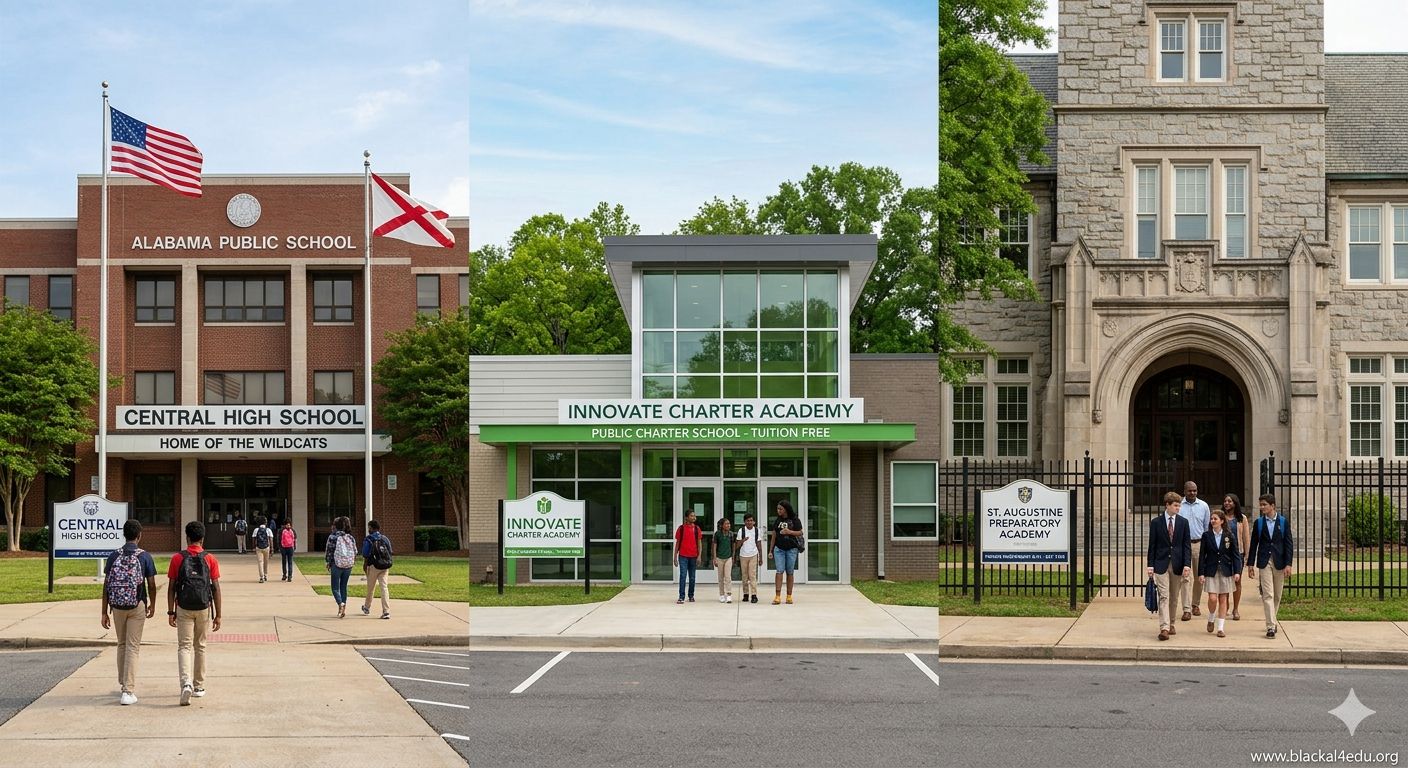
In Alabama, parents primarily choose between three main types of schools: Traditional Public Schools, Public Charter Schools, and Private Schools. While they all share the fundamental goal of educating students, they operate under vastly different frameworks regarding funding, regulations, curriculum, and admissions.
This comprehensive guide breaks down the core differences between these three options in Alabama to help you make an informed decision for your family
1. Traditional Public Schools
Traditional public schools are the bedrock of Alabama’s education system. They are managed by local school districts (such as county or city school boards) and overseen by the Alabama State Department of Education (ALSDE).
-
Funding: Public schools are primarily funded by taxpayer dollars, including local property taxes, state funds (via the Education Trust Fund), and federal funding. Because of this, tuition is 100% free for all students.
-
Admissions & Enrollment: By law, traditional public schools must accept every student who resides within their designated district boundaries, regardless of academic ability, special needs, or socioeconomic status.
-
Curriculum & Standards: Alabama public schools are strictly mandated to follow the Alabama Course of Study standards. Students must participate in state-standardized testing (such as the ACAP). Teachers in these schools must hold valid Alabama teaching certifications.
-
Governance: They are governed by publicly elected or appointed local school boards, meaning community members have a direct say in school leadership and policies through local elections.
Best for: Families looking for a tuition-free education close to home, robust special education services (backed by federal IDEA regulations), and a diverse, community-centric environment.
2. Public Charter Schools
Public charter schools are a relatively newer addition to Alabama’s educational ecosystem, authorized under the Alabama School Choice and Student Opportunity Act passed in 2015.
-
Funding: Like traditional public schools, charter schools are tuition-free public schools funded by local and state tax dollars. However, they do not receive funding for facilities in the same way traditional schools do, often relying on private grants or donations for building costs.
-
Admissions & Enrollment: Charter schools are open to any student living in Alabama. They cannot use academic or admissions tests. If a charter school receives more applications than it has available seats, it is legally required to hold a blind, random lottery to determine enrollment.
-
Curriculum & Standards: This is where charters differ significantly. They operate under a “charter” (a performance contract) that grants them autonomy over their curriculum, school calendar, and teaching methods. In exchange for this flexibility, they are held to strict accountability standards; if they fail to meet academic or financial goals outlined in their charter, they can be shut down.
-
Governance: They are governed by independent, non-profit boards rather than the local elected school district board.
Best for: Parents seeking a free public education option but wanting an alternative learning model, specialized thematic focuses (like STEM or arts), or a smaller, more flexible school culture.
3. Private Schools
Private schools operate entirely outside of the public school system. Alabama has a wide array of private schools, including independent preparatory academies and faith-based (parochial) institutions.
-
Funding: Private schools do not receive government funding. They are funded entirely through tuition, fees, and private endowments. Tuition rates vary wildly across Alabama, ranging from a few thousand dollars to upwards of $20,000+ per year. (Note: The Alabama Accountability Act and the newly passed CHOOSE Act offer tax credits and education savings accounts to help eligible families offset private tuition costs).
-
Admissions & Enrollment: Private schools have selective admission criteria. They can require entrance exams, interviews, academic transcripts, letters of recommendation, and behavioral records. They have the legal right to deny admission or expel students who do not align with their code of conduct or academic standards.
-
Curriculum & Standards: Private schools have complete freedom over what they teach. They do not have to follow the Alabama Course of Study, nor are they required to administer state standardized tests (though many choose national standardized tests like the Iowa Assessments). Furthermore, private school teachers are not legally required to hold Alabama state teaching certifications.
-
Governance: They are governed by private boards of trustees, religious organizations, or corporate owners, entirely free from state department oversight.
Best for: Families seeking specific religious instruction, highly rigorous college-prep curriculums, smaller class sizes, or exclusive extracurricular networks, and who have the financial means (or qualify for financial aid/state scholarships).
Public vs. Charter vs. Private in Alabama: Quick Comparison
| Feature | Traditional Public Schools | Public Charter Schools | Private Schools |
| Tuition | Free | Free | Paid (Tuition-based) |
| Funding Source | Local, State, & Federal Taxes | Local & State Taxes; Grants | Tuition, Donations, Endowments |
| Admission | Guaranteed (based on residency) | Lottery-based (if oversubscribed) | Selective (Testing/Interviews) |
| Teacher Certification | Required | Required (with some state flexibility) | Not required by state law |
| State Testing | Mandatory (ACAP, etc.) | Mandatory (ACAP, etc.) | Not required |
| Special Education | Fully mandated & funded by IDEA | Mandated by IDEA, but resources vary | Not bound by federal IDEA mandates |
Key Legal and Financial Updates to Keep in Mind
When exploring options in Alabama, it is vital to stay up to date on legislative changes that impact school choice:
-
The CHOOSE Act (Education Savings Accounts): Passed recently, the CHOOSE Act establishes the Creating Hope & Opportunity for Our Students’ Education (CHOOSE) program. This provides eligible Alabama families with Education Savings Accounts (ESAs) worth up to $7,000 per year to help fund private school tuition, tutoring, or other approved educational expenses.
-
The Alabama Accountability Act: This program provides tax-credit scholarships to low-income students zoned for “failing” public schools, allowing them to attend participating private schools or non-failing public schools.
Conclusion: Which is Right for Your Child?
There is no “one-size-fits-all” answer to education in Alabama.
-
If you want a reliable, community-embedded school with robust federally mandated support services at no cost, your local public school is an excellent choice.
-
If you want the innovation of a specialized curriculum or unique teaching philosophy without the price tag of tuition, look into Alabama’s public charter schools.
-
If you prioritize faith-based education, highly specific learning environments, or smaller class cohorts, and are prepared to navigate the admissions and tuition process, a private school might be the ideal path.
At www.blackal4edu.org, we are committed to keeping Alabama families informed about their educational rights and opportunities. Explore our website for more resources on school performance data, scholarship opportunities, and educational advocacy.